


This is an essay from GRIEF AND MEDIA. For more like this, plus my newsletter and video series, consider becoming a subscriber.
I am a reality television connoisseur. I once over-exaggerated a stomach ache to stay home from school (and I fucking love school) to watch an America’s Next Top Model marathon. I would sneak watch A Shot at Love with Tila Tequila when I was 11; I was captivated when my sister showed me Boston Rob and Amber’s season of The Amazing Race and would later watch Survivor with her and my parents every Wednesday night. My first full-time job was working at E! News on its social media team—I was the Twitter strategist, a lane I was trusted with because of my nonstop usage of it in the 2010s, so I live tweeted The Bachelor and sometimes Big Brother during my work week. I take reality TV seriously.
Reality TV is seen as a guilty pleasure, as low-brow slop; I thought this general opinion changed in recent years, until I blocked someone on Substack last week for saying our brains are rotting by pretending Love Island is worthy of academic discussion. What makes Big Brother and The Odyssey so different, really, other than thousands of years between their first telling? No matter the media, we derive meaning and lessons from it; we use it as a tool to understand our own world, values, and morals.
After a years-long break, I am locked in to Big Brother once again. I started watching the show in its 17th season, in 2015. I already listened to Rob Cesternino’s Survivor coverage, so entering the Big Brother fandom and live feed updates was an easy transition. For those uninitiated, Big Brother is a social strategy competition show in which contestants—houseguests—live in a house—a soundstage in Studio City—isolated from the real world and vote out—evict—someone each week. In the end, about three months after its start, a jury of evicted houseguests select the winner of the season from the final two remaining. As its name suggests, viewers can log onto Paramount Plus at almost anytime to watch what the contestants are presently doing in the house. It is surveillant, parasocial, voyeuristic, and immoral. This is true for all reality television, but Big Brother is unafraid to be upfront about it.
This season, I am struck by a particular conversation in which a contestant used their dead mother to build trust with another and how fans reacted to this game move.
Season 28 of Big Brother features ‘reality icons’ as houseguests—a former player in Angela Murray and two Survivor players, Dee Valladares and Rick Devens. They quickly formed an alliance and brought in other contestants, forming a house majority and being safe the three weeks since the season began. Another contestant, Jason De Puy, was on RuPaul's Drag Race as Salina EsTitties, but did not enter the house as a ‘reality icon.’ Jason didn’t share this with the other former reality stars, something fans considered a bad move given their majority positioning.
However, he and Angela formed a bond. In the beginning of the season, they had a conversation in which Jason opened up to her about feeling isolated being “around this many straight people” and trying to connect with people he doesn’t “feel safe around” to which Angela shares her son is gay and she will be Jason’s “proud mama bear” in the game.
Days later, they discuss their game relationship while cuddling in bed. Jason says, “My mom recently passed away. So I said if there’s a mom in the house, that’s my mom and I need to protect her.” Jason and Angela hug and cry, and Angela says, “They brought you here for me. … I’m here for you.” After Angela walks out of the room, Jason looks directly at the camera, rolling his eyes and laughing. He explains his thought process in a confessional: “Being emotional around Angela gives her purpose to come and be mama of the house. If I can up the ante, and put on the waterworks a little bit more so she feels emotionally attached to me, I’ma use it.“ He shares his strategy with two other contestants—Drew and Melody—which gets back to Angela, leading to a dramatic nomination ceremony fight in which Angela is in an egg costume. (My favorite Reddit comment as of late was of someone expressing frustration that they can’t recommend Big Brother to anyone because it’s just too embarrassing.)
Fans were upset.



For some, Jason’s game move was immoral.

I’ve been thinking about morality lately. I read this piece by Anastasia Berg’s The Point in which they discuss ‘shooting and crying,’ the term describing how soldiers, particularly IDF soldiers, show remorse which “enables rather than curbs moral disaster.” The idea is that the person ‘shooting and crying’ knows that they are doing something wrong, still does it, but thinks they’re absolved by knowing it was an immoral act. As Anastasia writes: “all too often you are not really crying for anyone but yourself.”
An example that I see in the San Francisco Bay Area: Teslas with stickers that say "I bought this before we knew Elon was crazy" or “Anti-Elon Tesla Club.” This sticker, its owners must think, absolves all wrong-doing—as if posturing themselves as anti-Elon Musk, despite giving him tens of thousands of dollars and driving around a symbol that represents him, means they are moral. They could instead trade in their Tesla, but they figure a $7.99 Etsy sticker is enough to communicate that they aren’t like other Tesla owners. Shooting and crying.
Keke Palmer discussed a similar idea in an Instagram post last week: “We are all on a different side of the same contradiction… You got a Tesla… you care about the Earth; you’re trying to do something good for the environment, but you’re the reason Elon was able to buy Twitter.”
She argues we’re all living “morally unethically”: “The next time you see or think about commenting on someone’s page about how much more ethical they could be living, remember you’re doing it all on Mark Zuckerberg’s internet. So before we start talking about everybody else, we got to get our backyards in order.”
We all have hard lines of what we would and wouldn’t do morally, yet a lot of our decisions live in a grey area. Life is a constant negotiation of our moral code. This is why we turn to media: We need tools and tangible examples to understand why we would, or wouldn’t, act in certain ways.

When themes of death or grief are mentioned in a show I’m watching, my ears turn like sonars. Reality television is a medium in which grief stories are being told—if you cast real people, you’re going to get moments of real grief. I’ve long argued that in order to normalize conversations about grief, we need to be okay when it looks different than how we would handle it. Perhaps you, dear reader, would not discuss your late mom to connect with a person in the game, but someone else will.
My research and work, if it isn’t already clear, examines and contemplates grief—how we think about it, how we use it to understand the world around us. I find myself interested in transgressive grief, the kind of grief that breaks societal expectations of what it’s supposed to look like. Grief is expected to be linear and definitive; it must be sad and depressing, but only for a certain amount of time!; you must reach acceptance, or else maybe you’ll never be healed (and if you’re healed, you too can be ‘normal’ once again!). I had someone in graduate school tell me it’s crazy that I do grief-related work because I’m too bubbly; another person told me I’m not over my parents’ deaths enough to do this work. So which is it? Once we let go of biased ideas on what grief is supposed to look like, we can let it be what it actually is: anything that a griever experiences.
I do not believe Jason’s move was immoral. Audiences crave villains in the media they watch—complex characters who take actions informed by their complexities—then clutch their pearls when someone acts in a way they wouldn’t. This is a game, people! Besides, every single contestant in a social competition game, especially one as long as Big Brother, discusses their personal lives and families in order to form bonds within the game. A player discussing a loved one to another player, whether dead or alive, is done to further a game bond. Wouldn’t, then, any discussion of family within a game setting be immoral? Or is it only immoral when it lands outside the radius of our own experiences?
I want my reality television to be full of grief and complexities and real people making real decisions for themselves. This is what connected me to the genre as a kid, and it is why it’s worthy of discussion. Jason was evicted by his fellow houseguests yesterday: bad news for me (a new fan of his!) and an example of how moral posturing within reality TV impacts both players and the audience.
In his exit interview with Entertainment Weekly, Jason says he’s a “showgirl.” And what is reality TV if not putting on a show?
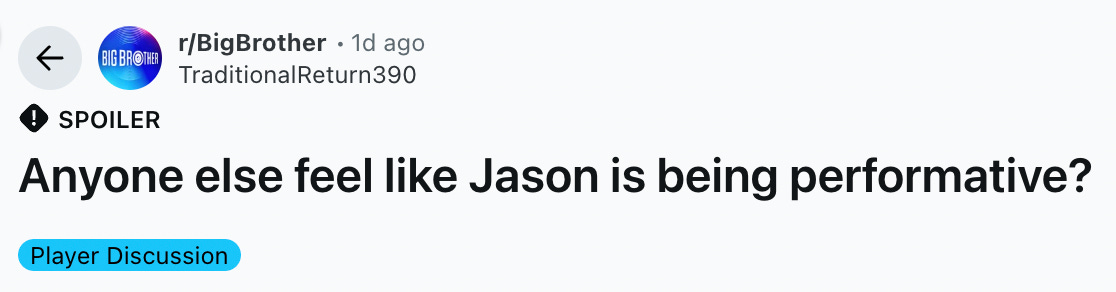
But, of course, people are going to have a problem with that, too.
Thank you for reading. If you liked this essay, please subscribe and share with a friend!

Ok this is the first thing you’ve written that I’ve read and you are hitting all of interests at once! Love this piece. Agree, more grief on reality tv! And more villains who are grieving too!
The confessional is doing a lot of work in how that scene gets read. Everyone adjusts how much grief they let show depending on who's in the room. Jason just had to say it out loud into a camera.