


This is an essay from GRIEF AND MEDIA. For more like this, plus my newsletter and video series, consider becoming a subscriber.
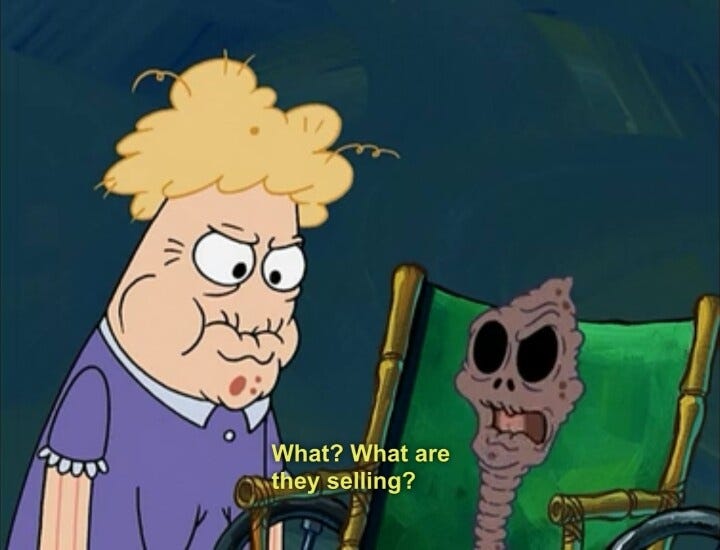
I’ve been sitting on this essay for a couple months now, because I wanted it to be perfect and also I guess I was working on a thesis and anticipating the end of grad school and all of that. The time has finally come for me to talk about aging, because all fears surrounding it are entirely rooted in a fear of mortality. Which, fine!!!! Fearing death is normal; who doesn’t? But if we want to get less weird about grief, we have to get less weird about aging, too.
This fear is everywhere. The Cut seems to regularly share essays on how everyone is getting injections; influencers in their early 20s are posting TikToks bringing viewers alongside them to get ‘preventative botox’; this week’s premiere episode of Love Island USA season 8 had a contestant in their early 20s calling a 29-year-old contestant surprisingly baby-faced, as if being born in 1996 means you’re turning 60 this year. It’s overt, and it’s subtle, and it’s everywhere—in my own home, I look in the mirror and wonder if I'm too expressive in my forehead to keep up the facade that I’m not an unc yet or whatever.
It’s everywhere if you pay attention. Maybe as a 30-year-old woman, I’m supposed to pay attention.
In the last year, Paige DeSorbo, of Giggly Squad and previous Summer House fame, announced on her podcast that she got botox. Despite my love for popular and celebrity culture, I am not someone who often feels particularly parasocial towards celebrities and influencers. However, some media formats require a certain level of encouraged parasociality for creators to build their following. Paige and her co-host Hannah Berner call their listeners the gigglers; when Paige announced her break up with Southern Charm’s Craig Conover, she announced it on the podcast, saying, “obviously I would come to the gigglers first,” and that she “would never cry on the internet, but, like, it’s okay if I cry on the pod.” This is strategic: She trusts the audience, so the audience can trust her. And I do, in ways. As a result, I trust her in a manner I don’t with other celebrities. Thinking about it critically, I decided I like listening to Paige because she reminds me of a family member. (I also feel this way about Survivor podcaster Rob Cesternino. It might be an Italian-American former-reality-star thing for me.) Perhaps that’s the point.
I distinctly remember watching a Giggly Squad clip on Instagram a year or two ago and thinking: Paige hasn’t gotten botox. Maybe I don’t need it either. Then Paige decided to get botox. Oh shit… am I going to need it in my early 30s too?
I found myself thinking about it more and more. Every time I looked in the mirror (which is often… I love a mirror!), it became an examination of how deep my (essentially nonexistent) wrinkles were. I did my skincare routine, morning and night, paying extra attention to moisturizing my neck and rubbing cream under my eyes. In this way, skincare shifts from a self-care ritual into a self-hatred, societal-appeasing drill—a drill done as my first task when I wake up and my final task before bed, defining the rest of my day as it is sandwiched in between.
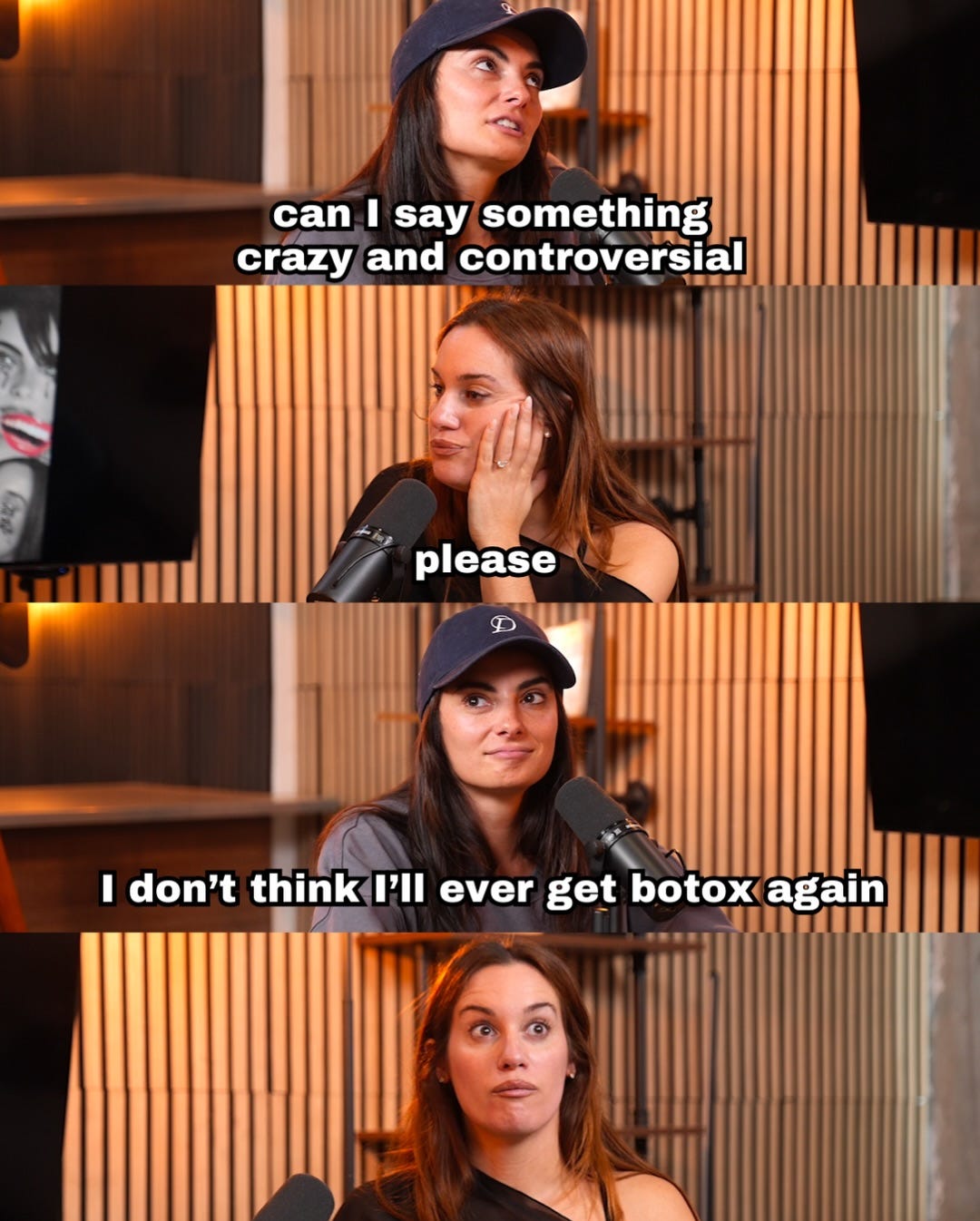
This spring, Paige shared on her podcast that she doesn’t think she will get botox again. And, honestly, I felt a little relieved. I do not want to want botox; I suppose I am looking for permission from someone—society? Other women?—to not get it.
Yet I see the way commenters on social media react when someone questions botox: Who the fuck cares? Let women do what they want to do! I’m more interested in seeing what women succeed in than what they look like doing it.
Botox is so normalized for women specifically that people act like challenging it is anti-feminist. How have we gotten here?
Anthropologist Ernest Becker, in his book The Denial of Death, discusses the concept of immortality projects, which allow us to evade our own mortality in some way. Think careers or children or art—these are projects we work on in life to distract us from our eventual death and to leave a legacy behind after we die.
What happens, then, when youth becomes an immortality project? Sure, looking in the mirror and seeing someone who looks, say, 27 instead of 32 will, in theory, create more distance between now and death. But what becomes this person’s legacy when they die? Wow, they weren’t young, but they sure looked it.
I think of people I know who died young, far too young, and the first thought is of their youth—that they had so much potential and so much more to experience. If we actually have experienced life, and actually have accomplished goals we hoped to accomplish, wouldn’t we want that to be what people say about us? Aging is not a bad thing; it’s, frankly, the point of life. It is a gift to experience life and to define what it means for us, immortality projects and all.
I last saw my mom when she was 67 and my dad when he was 61. I would love to see my parents age. If they were alive, my mom would be 71, and my dad would have just turned 74 in April. What would they look like at these ages? What would be my mom’s favorite book she read this year? What TV shows would my dad and I watch together? Where would my mom and I like to get coffee together? How would my dad want to celebrate his birthday week this year?
Who would they be if they had the opportunity to age even more?
I wish so badly I could see it. And I wish I had the opportunity to age alongside them. I imagine they had these thoughts about me; the ages they got to see me at were so special because they were so uniquely me at specific points in time. My age 8 was entirely different from my age 17, as was my age 25. If my mom got a glimpse of me now at 30, four years since she’s been here, I would hope I’m different; I want my face to reflect all that I’ve been through, all that I’ve gotten to experience.
This is not meant to criticize anyone who made the choice to get botox themselves. I have no idea how I’ll feel five, 10, 20 years from now, and societal pressure can be extra loud in an already impossible chase for immortality. This is more so a critique on the very real societal expectation on women to not age, that only rewards them when they never die. Impossible standards that none of us can ever meet.
Thank you for reading. If you liked this essay, please subscribe and share with a friend!
this is lovely, thank you for sharing! we need to be more appreciative of the fact that aging means being blessed with more life, which is such a gift <3
Whenever someone complains about “getting old” I refrain “it’s better than the alternative!” … and yet here I am scrutinizing my face. thanks for writing this! Very relatable!